A year of work behind CHORUS' Work Package 1, and what it means for the rest of the project
Before any autonomous shuttle can pick up a passenger, before any algorithm can reroute a delivery van around a cyclist, someone has to answer a set of much older questions: What do people actually need from their streets? Who gets to decide how a self-driving vehicle behaves near a school, a market, or a cycle lane? And who is accountable when things don’t go as planned?
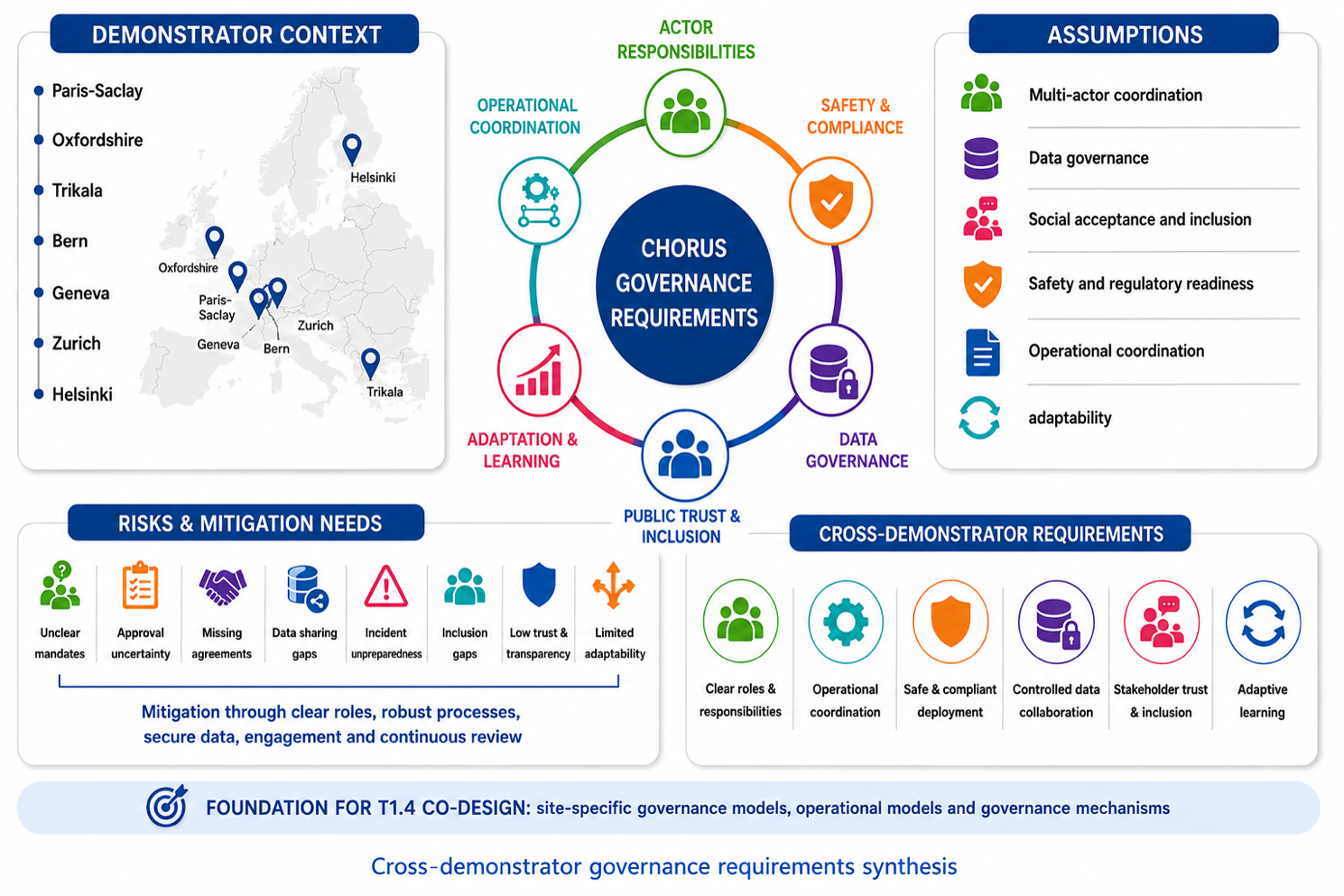
Those questions have occupied Work Package 1 (WP1) of the CHORUS project for most of the past year. On paper, WP1 is titled “Strategic Planning for Multi-Actor Orchestration”: a description that undersells the work involved. Coordinated by FIT Innovation, with contributions from the consortium and partners across all seven CHORUS demonstration sites (Paris-Saclay, Oxfordshire, Trikala, Bern, Geneva, Zürich and Helsinki), WP1 is not where CHORUS’s visible technology takes shape. It is where the groundwork for that technology gets laid: the requirements it has to meet, the legal boundaries it has to respect, the use cases it has to serve, and the governance arrangements that keep a project of this scale, spanning four countries, moving in the same direction.
Understanding what people actually need
The first task, T1.1, led by FIT Innovation, began with direct engagement rather than desk research. Local stakeholder forums were held at each of the seven sites, bringing together public authorities, transport operators and infrastructure managers. Community workshops extended that conversation to residents directly, with deliberate attention to groups whose views are often left out: older pedestrians and people with mobility challenges among them. Online surveys, run in several languages, added a quantitative layer to what had emerged from the discussions.
The result was not a simple list of preferences, but a structured set of technical and societal requirements: expectations around data sharing, accessibility, and the conditions under which people would actually trust a vehicle sharing the road with them.

Establishing the legal and safety framework
Requirements of this kind mean little without clarity on whether a vehicle is legally permitted to operate, and who bears responsibility if something goes wrong. That question was addressed under T1.2, led by IDIADA, which examined the safety standards, data protection obligations and liability frameworks applicable to autonomous vehicles and the systems coordinating them. Reconciling European-level regulation with four distinct national legal traditions proved to be one of the more demanding aspects of the first year, if not the most visible one.
Translating requirements into concrete use cases
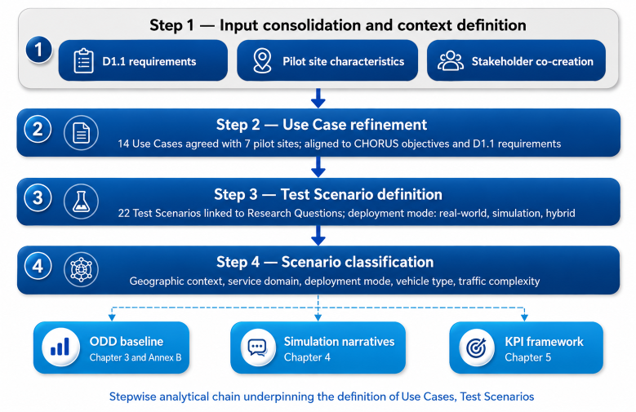
With requirements and legal boundaries established, T1.3, led by Frontier, set out to translate them into a form the rest of the project could design against. This work produced fourteen use cases, distributed across the seven sites (among them, a shuttle sharing road space with cyclists in Bern, a delivery vehicle operating in a pedestrian zone in Trikala, and a fleet adapting to variable congestion in Paris-Saclay). Each use case was paired with test scenarios and performance indicators, along with an initial definition of the operating conditions (weather, traffic density, road type) within which vehicles at each site are expected to function safely.
Clarifying roles and responsibilities
The fourth task, T1.4, led by TTS Italia, addressed a question that is simple to state and considerably harder to resolve across seven different local contexts: when a municipality, a transport operator, a technology provider and a regulator all have a stake in the same service, who is responsible for which decisions? T1.4 developed governance models setting out roles and coordination mechanisms for each demonstration site, so that these arrangements are agreed in advance rather than negotiated under pressure once vehicles are operational.
Why this work matters for the rest of CHORUS
The outputs of WP1, documented in deliverables D1.1, D1.2 and D1.3, now feed directly into the rest of the project. The architecture under development in WP2, the traffic management tools being built in WP3, and the demonstrations planned for WP4 all draw on the use cases and requirements defined during this first year. The business models under discussion in WP5 similarly rely on the governance foundations established through T1.4.
None of this work is easy to put on camera. But by the time a shuttle begins operating in Helsinki, or a delivery robot completes its first pedestrian crossing in Geneva, it will be doing so within a framework built over the course of a year by residents, city officials and engineers across four countries: one stakeholder forum, one requirement, one governance decision at a time.